


A national buyer's agency collapsed owing more than sixteen million dollars, leaving hundreds of clients stranded. The real lesson for anyone hiring a buyer's agent is about the model, not just the money.
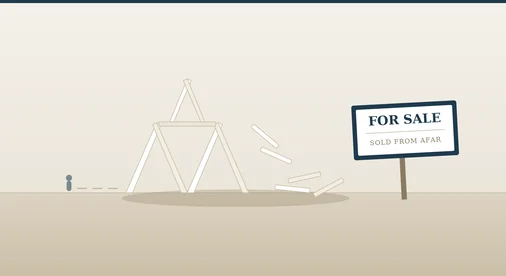
A national buyer's agency collapsed owing more than sixteen million dollars. The detail that matters for anyone hiring one is not the number. It's the model.
Dashdot went into voluntary liquidation on 28 May 2026. It was one of the largest buyer's agencies in the country, more than a hundred staff at its peak, a heavy social media presence, and a pitch built around proprietary software that picked investment "hotspots" in regional areas and capital cities. Clients paid tens of thousands upfront to have property found and bought for them, often in towns they had never seen, sometimes states away from where they lived.
According to a creditors' report filed with ASIC and reported by Capital Brief, Dashdot collapsed owing $16.57 million, with stranded customers cumulatively owed $10.6 million for prepaid services and refunds. The ABC reported that at least 700 clients could be caught up in it as unsecured creditors, and that the business had minimal cash at the point of collapse. Founder Glenn "Goose" McGrath, in an open letter, blamed worsening economic conditions, property-tax uncertainty and rising advertising costs, and said the balance sheet was not robust enough to absorb the shock.
I have no interest in kicking a competitor while he's down. Plenty of good operators have had bad years, and a collapse alone proves nothing about intent. What interests me is structural, because the structure is the part that repeats.
Strip away the specifics and Dashdot was a particular kind of business. National reach. A software-led promise that a good buy could be identified from data. Large fees taken upfront. And clients who, in many cases, were buying property remotely on the strength of a phone call and a spreadsheet.
That model has an obvious appeal. It scales. One system, one brand, buyers acquired through paid ads, properties sourced anywhere the data points. It's also the model that produced the mess. When the marketing spend that fed it slowed down, the ABC reported that McGrath himself pointed to an over-reliance on paid advertising as part of what brought the business undone.
The lesson isn't "big firms fail." It's that distance, in this job, is a cost that clients rarely price in until something goes wrong. It's also why I stepped away from the industry body rather than lean on the badge.
A buyer's agent who has never stood in the street is working from the same information you could buy yourself. Photos. Median data. A CoreLogic report. That's not local knowledge. That's a desk.
Local knowledge is knowing which side of the train line floods, which block of flats has a special levy coming, which agent overquotes by ten per cent as a matter of habit and which one prices honestly. It's having stood at the auction, watched who bids in this pocket, and knowing what a result actually means rather than what the headline clearance rate says. It's the same edge that surfaces genuine off-market properties before they ever reach a portal. None of that lives in software. It lives in the suburbs, and you only get it by being in them.
When the agency is national and the property is remote, that layer is simply absent. The client doesn't notice, because the shortfall is invisible right up until the moment it isn't.
There's a second structural point worth naming, and it's about how the fee is taken.
The ABC reported that customers were still being encouraged to proceed with Dashdot's services just days before it entered liquidation, and described a client who paid $23,100 shortly before the collapse, having been told the company was still actively searching for a property. Whatever the intent, the arrangement itself carries the risk: a large fee paid before the work is done sits on the wrong side of the table. If the business fails, that money is gone, and the client joins a queue of unsecured creditors. It's worth understanding how buyer's agent fees are normally structured so you can see when an arrangement is set up in your favour and when it isn't.
Real Estate Business and Broker Daily have since reported on ASIC documents showing that more than 95 per cent of Dashdot's shares were allegedly transferred to a British Virgin Islands company in 2024, two years before the collapse, for one hundred dollars. McGrath told SmartCompany the transfer was a "bona fide, genuine transaction" made for "personal reasons only," and no findings of wrongdoing have been made. The liquidator, Teneo, has said the concerns raised by creditors will be investigated. I'm not the person to adjudicate any of that, and I won't pretend to be. But you don't need a finding to take the practical point: where your money sits, and when it moves, is a question worth asking before you sign anything.
None of this is an argument against buyer's agents. It's an argument for asking a few plain questions and listening to the answers.
Has this person physically worked the suburb you're buying in, this year, not five years ago? Can they tell you something about the street that isn't in the listing? Is the fee structured so that you pay for a result, or are you handing over a large sum before anyone has done anything? And if the firm disappeared tomorrow, what exactly have you lost? The same discipline applies to the property itself, which is why a proper due diligence checklist matters as much as vetting the agent.
Those questions don't require you to distrust anyone. They just move the risk back to where it belongs. A good operator will answer them without flinching, because a good operator has already thought about them.
I work a defined patch of Melbourne, inner and bayside, on purpose. Not because a wider net would be harder to cast, but because the value I offer evaporates the moment I'm advising on a suburb I don't actually know. If you're weighing up an agent, local or otherwise, and you want a second read on whether the arrangement is set up in your favour, send me the details and I'll tell you straight.
This is general commentary, not financial or legal advice. It refers to matters reported by ABC News, Capital Brief, Real Estate Business, Broker Daily and SmartCompany; where allegations are noted, no findings have been made and the individuals named are entitled to the presumption that reported concerns remain unproven.
If you’d like to talk it through, we can map out the next steps.
No obligation. Just context.


It all starts with a confidential conversation.



.svg)

.svg)