


Prices softened in the June quarter, but the national number hides which pockets actually fell and why.
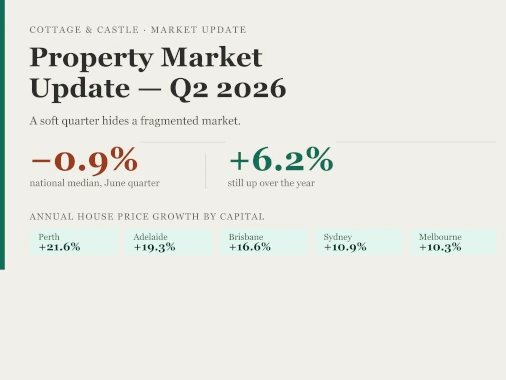
Prices softened across most capitals through the June quarter. Here is what the data actually shows, and why a market catching its breath is not a market in trouble.
House prices fell across most of our capital cities through the June quarter, and the rate of decline picked up. You will have seen the headlines already. Crash. Correction. Crisis. Most of those words are chosen to unsettle you, not to inform you.
So I want to walk through what the numbers say, because the picture is more fragmented, and more ordinary, than the coverage suggests.
The national capital city median house price dropped 0.9% over the quarter. That is the second consecutive monthly fall and the sharpest since August 2022. But a single national number hides more than it reveals. There is no one Australian property market. There are many, moving at different speeds, for different reasons. Units are holding up better than houses. Some pockets are still rising while others sit flat. The question worth asking is whether this is the start of something serious, or a market pausing after three unusually strong years.
Context first. National capital city house prices rose roughly 25% over the past three years. Spread across that period, the annual figure sits close to the long-run average for Australian capital city house prices, which is around 7% a year through the peaks and troughs of the last four decades.
That matters. A market does not climb 25% in three years and then hold that pace forever. Affordability barriers build. Buyers who were going to move have moved. Sellers who were going to sell have sold. Demand that has been satisfied stops pushing prices higher. This is the cycle doing what the cycle does.
The run was extended a year ago by rate cuts, which lifted borrowing capacity and pulled buyers back in. But the peak arrived late last year. An easing was always coming, simply because buyers had run out of room to pay more. Three consecutive rate rises to start the year sharpened that, and the sharper edge of the market is where confidence tends to leave first.
Here is the part the national number buries. The 0.9% quarterly fall was, in large part, a Melbourne and Sydney story, because a weighted national measure leans on the cities that transact the most.
Over the June quarter, Sydney house prices fell 1.1%, Melbourne 1.4%, and Canberra 1.9%. Perth held steady. Darwin, a small and volatile market, actually rose 1.4%. Adelaide edged down 0.2% and Brisbane 0.6%.
Now hold that against the annual picture, which tells a very different story. Over the year, Perth house prices rose 21.6%, Adelaide 19.3%, Brisbane 16.6%, Sydney 10.9%, and Melbourne 10.3%. Every one of those is a double-digit annual gain. National capital city house prices are still up 6.2% over the year, even after two quarters of decline.
So the market is not falling. It rose hard, and it is now giving a little back at the top of the cycle.
Within Melbourne, the softness is concentrated, not spread. The prestige and inner-eastern market has been flat since Covid, and confidence there is genuinely thin. It is not unusual to see the inner east struggle to clear 50% at auction on a given weekend. Buyers and sellers in that band are simply choosing not to participate, and when the higher-priced pockets go quiet, they drag the citywide average down with them.
That is the trap in an aggregated figure. A weak inner east pulls the Melbourne median lower even where mid-price and outer pockets are steadier. The headline says Melbourne. The reality is a specific band of Melbourne.
Units held up better than houses almost everywhere. National capital city unit prices slipped just 0.2% over the June quarter, and were still up 5.9% over the year. Melbourne unit prices were flat over the month, which, set against the house numbers, counts as a strong result. Brisbane units rose again, and are up a striking 25.2% over the year.
The pattern is worth sitting with. In the exact market where house confidence is under the most pressure, units are quietly holding their ground. For buyers watching affordability and rental demand, that divergence is a signal, not noise.
Underneath the softer sales market, the fundamentals have not changed. Rental vacancy rates remain about as low as we have seen. That keeps upward pressure on rents, and it keeps the underlying demand for housing intact.
We are chronically under-supplied. Policy is doing plenty of rearranging on the demand side, but it does not build houses, and net migration will run above 200,000 in the coming year. The negative gearing changes are the clearest example of that rearranging, and they do not start until 1 July 2027. People who arrive do not bring a home with them. Add a labour market that is still holding, with unemployment easing back to 4.4% in the latest read, and you have a floor under prices that a soft quarter does not remove.
This is the point that gets lost. High interest rates and high unemployment do not coexist for long, because the first response to rising unemployment is to cut rates. A crash needs severe job losses, mortgage rates people cannot service, or a recession. None of that is currently in view.
We are in the winter market. It is the quiet stretch of the year by habit, and the test for the market is the spring revival, which usually begins to stir in August as people start thinking about buying or selling before year end.
The supporting conditions are lining up better than the headlines imply. Oil sits below US$70 a barrel, which eases the inflation outlook. As electricity subsidies wash out of the figures and the real price settles, the noise in the inflation data should settle too. If the rate picture clears over the next couple of months, buyer sentiment can shift faster than most people expect. Roughly 70% of the market is owner-occupiers moving house, not investors, and they are still getting on with their lives.
My read is that prices finish the year a little below where they started, and then the cycle moves on, as it always does. This is not forecasting. It is structured observation about direction. Spring has followed winter for a long time.
A softer market rewards preparation and punishes panic. The buyers who look back on this period well will not be the ones who sold in fear or sat on the sidelines waiting for perfect conditions. They will be the ones who understood the cycle, stayed patient, and bought quality assets in the right locations.
The risk right now is not missing a property. It is making an unstructured decision in a market where the averages are actively misleading. A citywide median that reads down 1.4% tells you almost nothing about the specific pocket, the specific property, and the specific negotiation range in front of you. Comparable sales analysis in the right pocket does. That gap, between the headline number and the property-level reality, is exactly where careful buyers do well and rushed ones overpay.
If you want a second, independent read on where a specific suburb sits in its cycle, or on whether a property in front of you holds up under scrutiny, that is the conversation to have. You can book an initial review, or send me the details of what you are looking at.
This is general market commentary, not personal financial or investment advice. It does not account for your individual circumstances.
If you’d like to talk it through, we can map out the next steps.
No obligation. Just context.


It all starts with a confidential conversation.



.svg)

.svg)