


Hampton sits between Brighton's prestige and Sandringham's quiet, without trying to be either. A buyer's advocate's view of the bayside suburb, covering Hampton Street, the beach, schools, sub-markets, and the practical decisions buyers face when comparing the wider corridor.
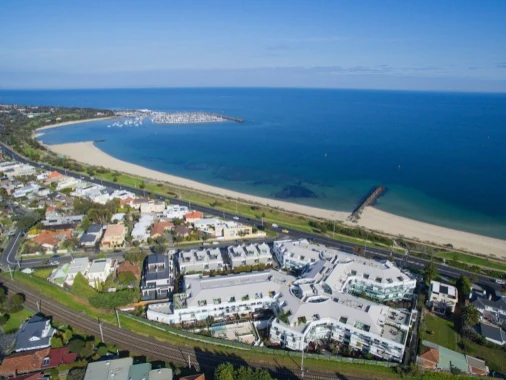
Hampton is the bayside suburb that sits between Brighton's prestige and Sandringham's quiet, without trying to be either. Postcode 3188, City of Bayside (the same council as Brighton), Sandringham line, fourteen kilometres south-east of the CBD. The suburb is family-driven, has a single dominant commercial spine, and one of the calmer bay beaches in inner-south Melbourne.
The positioning is straightforward. Brighton (immediately north) carries the prestige tier, the bathing boxes, and the price ceiling. Sandringham (immediately south) is quieter again and sits as the southern terminus of the train line. Hampton occupies the middle. It is more affordable than Brighton 3186 for equivalent stock, more walkable to a single dense shopping strip than Sandringham, and shares the Bayside Council, the school catchments, and most of the lifestyle with both neighbours. Buyers regularly consider all three. This profile covers Hampton.
Three things define the area's identity. Hampton Street, the suburb's commercial spine, is the daily-amenity backbone and one of the more dense bayside commercial strips. Hampton Beach, with its calmer water, accessible foreshore, and family-friendly character, is the recreational anchor. The school cluster (Hampton Primary School, Sandringham College zone, plus access to the Brighton independent schools) anchors the family-buyer market that drives most of the suburb's transactions. Each shapes a section below.
Three patterns dominate the residential fabric.
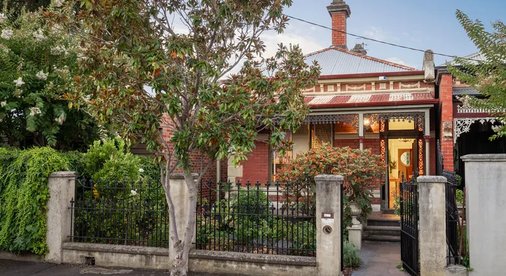
The dominant building type is the Edwardian, Federation, and California Bungalow family house on a substantial block. The streets between Hampton Street and the foreshore (Linacre Road, Littlewood Street, The Avenue, Ocean Street, Holyrood Street) carry the most consistent period housing. Land sizes typically sit between 500 and 800 square metres. Heritage protection is substantial without being as dense as Brighton's Esplanade-fronting precinct.
The second pattern is the inter-war and post-war family housing east of Hampton Street. More modest blocks, more 1920s to 1960s housing, and the practical entry tier for buyers wanting a freestanding house in 3188.
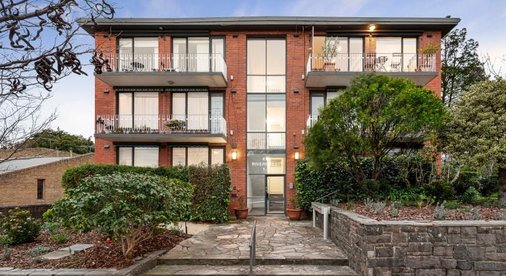
The third pattern is the contemporary medium-density stock and the Hampton Quarter mixed-tenure development near the station. Hampton Quarter completed in early 2024. It combines 159 private apartments with 18 social housing dwellings across four buildings on a single podium, designed by ARM and JAM Architects on former rail land. Whether the social-housing component changes the area's character is a question buyers raise during the early-conversation stage. The development is still too recent to draw firm conclusions from, but the integrated four-building format is comparable to other transport-oriented developments in inner Melbourne.
What the area doesn't have at scale: Esplanade-tier mansions on the Brighton scale, apartment density comparable to St Kilda, or genuinely affordable entry-tier stock at any sub-market.
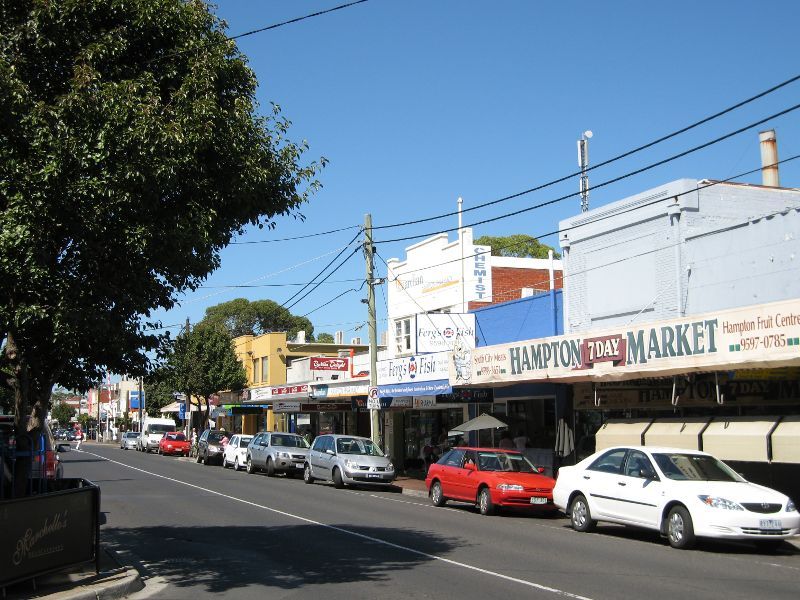
Hampton Street is the suburb's commercial spine and one of the more genuinely walkable bayside shopping strips. It extends roughly a kilometre north to south through Hampton, from South Road at the Brighton boundary down past Crisp Street. The densest commercial cluster sits around Hampton Station at the Hampton Street level crossing.
The retail mix leans heavily toward independent boutiques, cafes, butchers, bakers, wine merchants, and family-oriented services rather than chain stores. The cafe and brunch culture is genuine. Locals consistently cite The Hamptons Bakery as the destination artisan-bread-and-pastry venue, Lennox for its airy interior and brunch reputation, Pippa's Cafe Hampton for its friendly service, Glasshouse Hampton for specialty coffee, and Cabin Coffee and Deli for its neighbourhood feel. Cornerstone & Co, on Ludstone Street just off the strip, adds a more recent food layer.
Parking is the strip's recurring frustration. The strip is busy on weekends, side-street parking is permit-zoned, and foreshore parking on Beach Road fills heavily over summer. It is normal inner-suburban friction rather than an exceptional problem.
The strip's nightlife is bar-and-restaurant-led rather than bar-led. Hampton Street has no nightclubs and is not a destination for late-night entertainment.
Hampton Beach extends from the Brighton Beach boundary near the foreshore end of South Road south to the Sandringham boundary near Picnic Point. The Hampton Life Saving Club sits at the central swimming reach. The beach is calmer than the Brighton sections to the north, particularly through the southern boat-harbour section, where the water is more sheltered.
Historical sand-trapping work along the foreshore moved sand north and benefited Brighton Beach. The current Hampton beach is broad and clean but a quieter swimming destination than Brighton or Sandringham. Accessibility infrastructure (Mobi-Mat beach access, beach wheelchairs through the Life Saving Club, accessible pathways) is among the better bayside provisions.
For families, the beach works well. The water is sheltered, the foreshore reserve is wide, and the playground infrastructure inland (the Thomas Street South Reserve playground in particular) adds to the family-amenity layer. The Hampton Life Saving Club operates the Starfish Nippers program for children with disabilities, and the club is a real community anchor.
The beach has become increasingly popular with windsurfers and kite surfers over recent years. The combination of sheltered water and consistent onshore wind makes it a working spot for water-sports activity that doesn't fit at busier beaches.
The Hampton school cluster shapes a meaningful share of the suburb's family-buyer demand.
Hampton Primary School (Hampton Street, since 1913) is the local government primary and one of the better state primaries in the Bayside corridor. Zoned enrolment.
Sandringham College, the state secondary, operates from two campuses in Sandringham: Years 7 to 9 on Bluff Road, and Years 10 to 12 on Holloway Road. The college's recent performance is a real factor in family-buyer demand, and catchment access is one of the more meaningful premium drivers in Hampton's residential pricing.
Independent schools cluster in Brighton and at the Bayside corridor's edges rather than in Hampton itself. Brighton Grammar (boys), Firbank Grammar (girls), Haileybury's Brighton campus (co-ed, just over the Brighton East border), and Star of the Sea (Catholic girls) are all within practical commuting distance. Haileybury and St Leonard's are the most frequently named for Hampton-resident families.
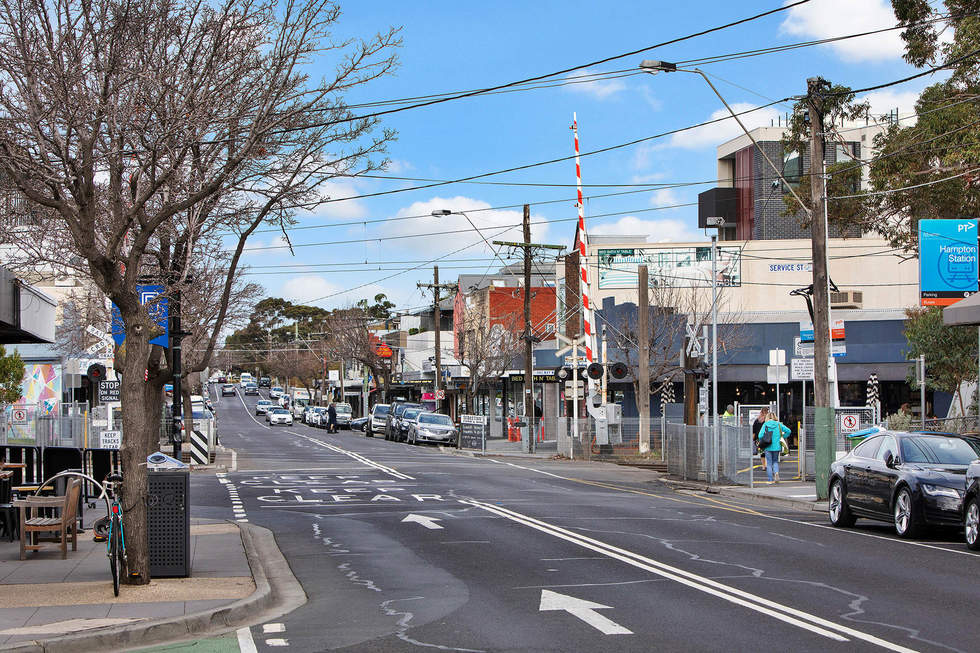
Hampton Station on the Sandringham line provides direct access to Flinders Street in under thirty minutes off-peak. The station is centrally placed for the suburb, with most residential addresses within walking distance.
Local buses connect Hampton along Beach Road to Brighton, Elwood, and St Kilda in one direction, and to Sandringham, Black Rock, and Southland in the other. A separate Bay Road service heads east from Sandringham through Hampton to Chadstone. Cross-town routes along Hampton Street reach Bentleigh and East Brighton.
By car, the major arterials are Beach Road (the foreshore), Bluff Road (the eastern boundary between Hampton and Hampton East), and South Road (the northern boundary with Brighton). Beach Road traffic is heavy on summer weekends. Nepean Highway, further east through Hampton East, is the standard arterial congestion point.
The Hampton Quarter and social-housing question. The mixed-tenure development near the station combines social and private housing across four buildings on a single podium. The integrated format is comparable to other transport-oriented developments in inner Melbourne. The development is still too recent to draw firm conclusions from, but the design and tenure mix are now familiar in the inner-south market. Buyers raising the question should treat it as an open question rather than a settled one in either direction.
The beach quality compared to neighbours. Hampton Beach is calmer and quieter than Brighton's Dendy Street section and Sandringham's central reach. Historical sand-trapping work affected the beach's character. Buyers expecting Brighton-tier foreshore amenity should walk both before deciding which suburb fits the brief better. Hampton Beach works well for families and water-sports, less well as a destination beach.
The Hampton versus Brighton East decision. Both sit within Bayside Council, both share most amenities, and both come in cheaper than Brighton 3186 for equivalent stock. The decision often comes down to school catchment access and the specific feel of the residential streets. Hampton is more village-and-beach in character. Brighton East is more modest family-house density. Buyers should compare both, with school zoning as the practical decision factor for most family briefs.
Three signals worth unpacking.
Signal one: tenure mix. Hampton is heavily owner-occupied. The renter share is one of the lower in the corpus, driven by family-house dominance and limited apartment supply. Buyers should expect a settled, long-tenure street character on most addresses.
Signal two: hold periods. Hampton's family-house market has long hold periods, with multi-decade tenures common in the heritage and inter-war pockets. Twenty-five-year holds are not unusual. The implication for buyers is that the visible market is a smaller subset of the actual housing stock.
Signal three: school-catchment premium. Address-level premiums tied to Sandringham College catchment access and Hampton Primary School zoning are real and quantifiable. Buyers should expect to pay premiums for in-zone addresses, particularly for the secondary catchment, which has tightened over recent years as the college's reputation has strengthened.
Three observable sub-markets in Hampton.
Period family houses west of Hampton Street. The streets between Hampton Street and the foreshore, including Linacre Road, Littlewood Street, The Avenue, and Ocean Street. Substantial blocks, period housing, walking distance to the beach and the strip. The premium tier of the suburb.
Family houses east of Hampton Street. The streets between Hampton Street and Bluff Road, with more inter-war and post-war housing on more modest blocks. The practical entry tier for buyers wanting a freestanding house in 3188.
Apartments and Hampton Quarter. The contemporary medium-density and mixed-tenure stock near the station. A smaller market than in any of the other corpus suburbs, dominated by downsizers and small-household buyers wanting walking access to the strip and the train.
A practical pricing note: the gap between the period-house pocket west of Hampton Street and the family-house pocket east of Hampton Street is meaningful and reflects both block size and walking-distance amenity to the foreshore and the strip. The gap between Hampton and Brighton 3186 for equivalent stock is significant and typically favours Hampton for buyers willing to swap bathing-box-tier prestige for the more genuine village character.
Families with primary- and secondary-aged children, particularly those targeting Hampton Primary or Sandringham College catchment access. The single clearest match for the Hampton brief.
Buyers wanting a genuinely walkable bayside suburb, with a dense commercial strip and beach access within ten minutes of most addresses. The compactness is one of Hampton's understated strengths.
Downsizers from larger Bayside or inner-east houses who want a smaller heritage residence near Hampton Street, at lower price points than Brighton.
Buyers prioritising the family-and-village brief over postcode prestige. Hampton feels more village-like than Brighton's larger and more dispersed character.
Long-term holders interested in heritage-protected period housing with one of the longest-tenure family-housing markets in inner-south Melbourne.
The area doesn't suit buyers wanting nightlife or a bar scene on their doorstep (Brighton's Bay Street and the Prahran corridor answer that better), or buyers expecting a multicultural or particularly diverse demographic (Hampton skews heavily white-Australian-professional-family).
The Brighton-Hampton-Sandringham decision is a single piece of work, not three separate ones. The three suburbs share the council, the train line, and most of the practical amenity. The choice between them comes down to school catchment access, price tier, and personal preference for village density versus prestige amenity. Buyers should compare all three explicitly rather than defaulting to the most expensive postcode.
Brief discipline matters. The three sub-markets behave differently, and the school-zoning question is the most consequential single variable for family briefs. Building condition and renovation potential vary substantially within the heritage stock, and proximity to Hampton Street and the foreshore are the practical premium drivers. We've helped clients across all three sub-markets, and the work is in matching the brief to the right pocket, the right school zone, and the right house.
For buyers comparing the wider corridor, Brighton sets out the trade-offs north, and Elwood covers the corridor continuation further north toward St Kilda.
If you’d like to talk it through, we can map out the next steps.
No obligation. Just context.


It all starts with a confidential conversation.




.svg)

.svg)